
BPC-157 vs. TB-500: What the Evidence Actually Says
BPC-157 and TB-500 compared honestly: how they're thought to work, how thin the human data is, their 2026 FDA status, and how to track recovery properly.
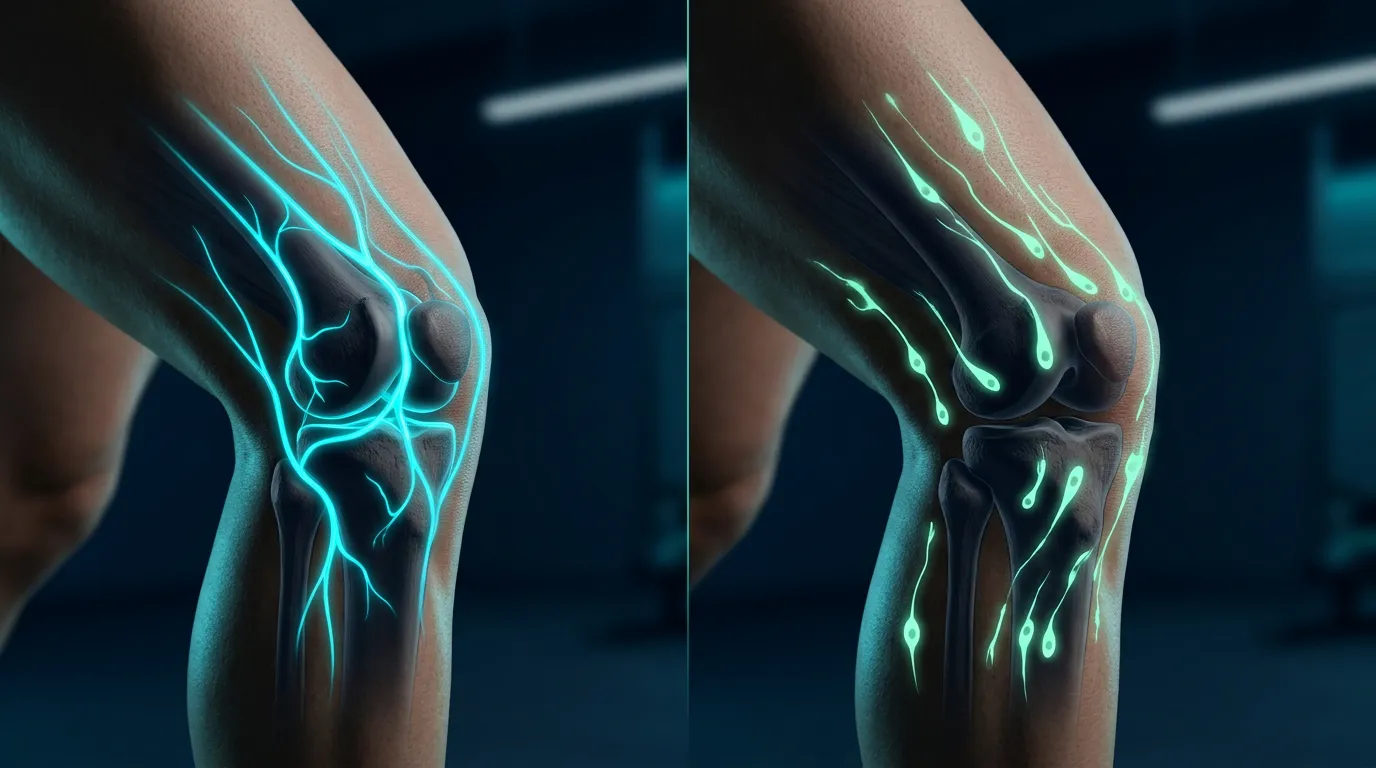
Two names come up more than any others when people talk about healing and tissue repair: BPC-157 and TB-500. Both have loyal followings in biohacking and sports recovery. Both get described as if they were proven.
They aren’t. That doesn’t make them uninteresting. It means you should know exactly what the evidence does and doesn’t show before you decide anything.
Two Different Mechanisms
BPC-157 is a synthetic 15-amino-acid peptide derived from a protein found in gastric juice. In animal and cell studies it seems to act on several repair pathways at once. A 2025 systematic review summarized the proposed mechanisms as more growth-hormone receptor expression, activation of pathways tied to cell growth and new blood vessel formation (angiogenesis), and lower inflammatory cytokines.
TB-500 is a synthetic fragment related to thymosin beta-4, a protein present in almost every human cell. Thymosin beta-4 binds actin, the protein cells use to move. The idea is that it helps repair cells migrate to where they’re needed.
A simple way to hold the difference in your head: BPC-157 is mostly discussed as improving the infrastructure of healing, like blood supply and growth signaling. TB-500 is about logistics, getting cells to the site. That’s a useful mental model, not a proven clinical distinction.
What the Studies Actually Say
Neither compound has completed large, controlled human trials for the things most people use them for. Here’s the honest picture.
BPC-157. The 2025 review in HSS Journal screened 544 articles and included 36. Thirty-five were preclinical. The one clinical study was a retrospective chart review of 16 patients with knee pain, with no control group, where most reported improvement. A separate pilot safety study gave intravenous BPC-157 to exactly two healthy adults and saw no problems in their lab markers. Interesting, but two people is not a safety profile. In rats and dogs, BPC-157 is cleared quickly, with a short half-life.
TB-500. The parent protein, thymosin beta-4, has more human data. It reached clinical testing for wound healing, and Treadwell and colleagues reported faster dermal healing in preclinical models and in some patients. TB-500, the fragment people buy online, is a different molecule with far less human research.
So: the mechanisms are plausible, the animal data is encouraging, and the anecdotes are everywhere. None of that is the same as “proven in humans”. If someone tells you otherwise, ask for the trial.
How to Read This Kind of Evidence
It helps to know the rough ladder of evidence, because BPC-157 and TB-500 marketing often skips from the bottom rung to the top.
Cell studies. Useful for understanding mechanisms. They tell you what a compound can do in a dish, not what it does in a body.
Animal studies. A real step up, and most of the BPC-157 literature sits here. But rats differ from people in physiology and dosing, and injuries in a lab are created in controlled ways that don’t look much like a torn hamstring from five-a-side football.
Case reports and chart reviews. Real patients, but no comparison group. People often improve after an injury anyway, especially when they rest and do rehab at the same time, so improvement alone doesn’t show the compound did anything.
Randomized controlled trials. The test that can actually separate a treatment’s effect from time, placebo and everything else. This is the rung that’s missing for both compounds and the outcomes people care about.
None of this means the animal data is worthless. It means it’s a reason to run human trials, not a substitute for them. When you read “studies show,” ask which rung those studies are on.
Use Cases People Talk About
You’ll see both compounds discussed for tendons and ligaments, muscle tears, joints and, for BPC-157, the gut. Most of that comes from animal models. BPC-157 has the longer research history in gastrointestinal models. TB-500’s interest comes from thymosin beta-4’s role in cell migration and wound repair.
What you won’t find is good human evidence telling you which one fits which injury. That’s the gap. If you have a real injury, a sports medicine physician or physical therapist who can examine it is worth more than any compound.
Status in 2026
Both peptides are in regulatory limbo in the US. The FDA took them off its Category 2 list in April 2026, and in July an advisory committee voted 8–6–1 in favor of each being allowed for pharmacy compounding. FDA still has to act on that vote. Until it does, neither is approved, and the FDA has previously sent warning letters to sellers marketing BPC-157 and TB-500 as unapproved drugs. We cover the bigger picture in What Are Peptides?.
If you compete, the answer is simpler: both fall under the WADA Prohibited List.
Questions to Ask Before You Do Anything
If you’re dealing with an injury and thinking about these compounds, a few questions will save you time and possibly harm:
- Do I have a diagnosis? “Shoulder pain” can be a tendon problem, a joint problem, a nerve problem or referred pain. Each needs a different plan.
- What does the standard treatment look like, and have I given it a fair try? For many tendon and muscle injuries, that means structured rehab, load management and time.
- What would tell me it’s working? Decide your measures before you start, using the tracking approach below.
- What would make me stop? New pain, swelling, redness or anything systemic should send you to a clinician, not to a forum.
- Can I verify what I’m buying? For gray-market products, usually not.
What About Combining Them?
Stacking the two is common in the community, based on the idea that the mechanisms complement each other. There’s no controlled human data on the combination. And every extra compound makes it harder to tell what’s doing what. If you can’t attribute an effect, you can’t learn from it.
How to Measure Healing Instead of Guessing
This is the part we care most about, because it applies to any recovery approach, peptides or not. “It feels better” is real, but it drifts with mood, sleep and the weather. Make it measurable:
Pain score. Rate the specific site from 1 to 10 at the same time each day. Same question, same time, every day.
Range of motion. Measure the joint with a goniometer app before you start and then weekly. Quantified range of motion is one of the clearest signs of real progress.
Function. Pick one or two movements that currently hurt, like a single-leg squat or an overhead press, and record whether you can do them, how many reps, and how it felt.
Context. Log sleep, training load and anything else that changed. If you started a new rehab program the same week, that matters. HRV is a useful extra signal for overall recovery load.
Scans or photos if the area is visible, under the same conditions each time.
Review the trend every couple of weeks against your baseline. If nothing measurable has moved, that’s information too. It might be the compound, the product’s quality, the diagnosis or the rehab plan. A clinician can help you figure out which. For structuring the whole thing over a few months, see our 12-week tracking guide.
The short version: neither of these compounds has earned the certainty people talk about them with. Your data can at least make your own experience honest.
A Worked Example (Illustrative)
Here’s a fictional example of injury tracking. The person and details are invented, and no compound is assumed.
Priya strains her Achilles while running. A sports medicine physician diagnoses a mild tendon injury and gives her a rehab program with gradually increasing calf loading.
Before starting, she records a baseline: morning pain on first steps rated from 1 to 10, the number of single-leg calf raises she can do before pain hits 3 out of 10, and a short note on how walking feels. She also notes her sleep and weekly running, which is zero for now.
Every morning she rates the first-steps pain. Once a week she tests calf raises the same way, at the same time of day, after the same warm-up. She logs each rehab session.
In weeks one and two, nothing much changes, which frustrates her. By week four, her morning pain averages lower and her calf raise count has climbed. A bad week in week five, after a long day on her feet at a conference, shows up clearly in her pain scores, and she can see why.
At week eight, she and her physician review the trend together and agree on a return-to-running plan. Whatever she might have added, the data shows the rehab is doing its job. If she had started an unproven compound in week one, she’d now be crediting it for progress that the rehab alone could explain.
Common Mistakes
Skipping the diagnosis. Treating “knee pain” without knowing what’s wrong is guessing.
Dropping rehab because a compound feels like a shortcut. Nothing in the evidence suggests these peptides replace loading and time.
Starting both compounds at once. If you improve, you won’t know why. If something goes wrong, you won’t know what caused it.
Measuring only pain. Pain fluctuates with sleep and mood. Pair it with something objective, like range of motion or reps.
Returning to full load too soon. Feeling better isn’t the same as being healed. Let your measurements and your clinician guide the return.
Trusting the label. A gray-market vial’s contents are unverified, which also means a “no effect” result can’t tell you whether the compound itself works.
Disclaimer: This article is for educational purposes only. BPC-157 and TB-500 are not FDA-approved for human use, and nothing here is medical advice or a recommendation to use them. Talk to a qualified healthcare professional about any injury or treatment, and check the laws where you live.
FAQ
Is BPC-157 or TB-500 FDA-approved?
No. Neither is an FDA-approved drug. Both were removed from FDA's Category 2 list in April 2026 and recommended by an advisory committee in July 2026, but that does not make them approved or authorized for compounding yet.
Can athletes use BPC-157 or TB-500?
Not in tested sport. Both fall under substances banned by the World Anti-Doping Agency, so competitive athletes should avoid them entirely.
How do I know if a recovery protocol is working?
Measure the injury, not your mood. Track a daily pain score for the specific site, range of motion, and one or two functional tests at regular intervals, and compare against a baseline you recorded before you started.